
July 21, 2026
Are Small Scholarships Worth Applying To? An Honest Look
TL;DR. Small scholarships are usually worth applying to — the math is on your side. The biggest national awards attract thousands of applicants; many smaller local and niche awards attract dozens. Submitting ten good-fit small applications usually beats one desperate application to a huge one. The bottleneck is application time, not award size — and the right workflow gets that time under control.
Are small scholarships actually worth the effort?
Yes — for almost every student. The "small" label misses what matters: most smaller awards have far fewer applicants than the giant ones, so your odds of winning one go up meaningfully, even when the dollar amount looks small. A $500 Rotary club award with 30 applicants is a much better bet than a $10,000 national award with 5,000 applicants, even though the headline number on the big award is twenty times larger.
The bigger intuition is even simpler: ten good small applications submitted on time often produce more total money — and far more wins — than one desperate attempt at a marquee scholarship. Most students who win meaningful aid apply to many small awards, not a few big ones.
Do small scholarships have better odds than big ones?
Almost always, yes. The ratio of applicants to awards is where the honest math lives:
Big national awards (the ones you find on the first page of Google for "scholarships") routinely attract thousands of applicants for a small number of slots. Some have acceptance rates under 1%.
Small local awards (a Rotary club, a county women's club, a hospital auxiliary, a local bar association) often attract a few dozen applicants because the pool that even hears about them is small. Acceptance rates of 10–20% are not unusual.
Niche / major-specific / identity-based awards (a state nurses' foundation, an engineering society's student grant, a first-generation student award) sit in the middle — the people who qualify and find them are a small subset of all students, so competition is softer than the giant pools.
The same principle drives every pool-odds decision you make: a smaller, less-known pool favors the applicant who shows up. See our local scholarships guide for the full post on where these awards actually live.
What's the difference between a small and a large scholarship?
There's no industry definition, but a useful rule of thumb:
Amount: small = $100–$1,500; medium = $1,500–$5,000; large = $5,000+.
Applicants: small = often dozens; medium = often hundreds; large = often thousands.
Where they live: small = local clubs, niche orgs, community foundations; medium = department-level, regional companies, smaller national orgs; large = big national brands, well-known foundations, sweepstakes.
Effort to apply: small = usually short — form, one short essay or none; medium = usually a bit longer — form, essay, sometimes a recommendation; large = often a full application — essays, recommendations, sometimes interviews.
Typical hit rate: small = 10–20% acceptance is common; medium = 3–10% is typical; large = under 1% for the marquee ones.
The dollar amount drives attention, but the applicant pool size drives whether you win. A small award with a small pool is almost always the easier win.
How many small scholarships should you apply to?
As many as fit your profile and your time budget. Two practical anchors:
For a single semester: ten to twenty small awards is a realistic, high-yield goal for a high-school senior spending 3–5 focused hours per week.
For a full application year: thirty to fifty small awards is the working range most successful applicants describe — even a few wins add up to a meaningful tuition reduction.
The number that matters more than the count is whether each award actually fits you. Ten well-fit small applications beat forty random ones every time. A profile-matched search engine is built for exactly this — start with our scholarship search index filtered by state, major, or affiliation.
What's the catch with small scholarships?
Three honest catches worth knowing before you commit:
Some are repeat-ask scams. A "fee to apply" or a "you've been selected, pay to claim" message is not a real scholarship — see our scholarship scam red flags guide for the full tell list. Real scholarships never charge a fee.
Some have tiny pools because no one knows about them. That's your edge — but it also means they tend to fill up fast once word gets out. A 60-day rolling-deadline local award can close earlier than the listed date if the committee picks a winner after 50 applications.
Verification and award processing can be slow. Smaller awards often have less administrative scaffolding. Plan for extra follow-up: confirm receipt, save the email thread, and don't assume the money is in your account until it actually is. Most legitimate awards are fine — just less automated than the big ones.
Those caveats don't change the math: the small awards are still your best odds. They just require a little more organization, which is what a deadline tracking habit is for.
How do you find small scholarships that fit your profile?
The fastest path is the same as for any scholarship: search by the things that already define you — your state, your major, your activities, your affiliations, your background. A few practical filters to start with:
State hubs surface awards that prioritize in-state students. Examples: Texas, Ohio, California.
Major hubs surface awards tied to your field. Nursing, engineering, and education are the most populated.
No-essay scholarships — if writing essays is what's blocking you, many smaller awards skip the essay entirely. The Top Ten List Scholarship (no GPA minimum, $1,500, open to all 50 states) is a good representative example.
Need-based scholarships if your FAFSA SAR or financial situation qualifies you. Smaller community foundations tend to be the highest-yield pool here.
Closing-soon for awards with deadlines inside the next 60 days — small ones get overlooked, so the closing-soon queue surfaces low-competition options you'd otherwise miss.
The point of searching by your profile is that "small" stops being synonymous with "random." A $500 nursing scholarship for Ohio residents who demonstrate financial need is small and high-yield for one specific student. The more you filter, the smaller and higher-yield each match gets.
Can you apply to small scholarships faster than big ones?
Yes — that's where the time math flips. Most small awards ask for less, so each one takes less, but the number of them rises. The trick is turning ten similar applications into one session of work rather than ten evenings. Three moves that actually work:
Reuse one essay skeleton across awards. Keep a strong personal statement and one "why this field" essay, then tweak the opening and closing per award. The full guide lives in our scholarship application checklist — most committees expect overlap and penalize only essays that ignore the specific prompt.
Batch similar awards by deadline week. Group your saved list by "due in October," "due in November," etc., and clear a week in one sitting. Your brain switches less, your output rises.
Use auto-fill where the form lives on the open web. A Chrome extension that drops your name, GPA, and essays into each form turns a 20-minute application into a 2-minute one. The cumulative effect — ten applications in an hour instead of a weekend — is the difference between applying to ten and applying to forty.
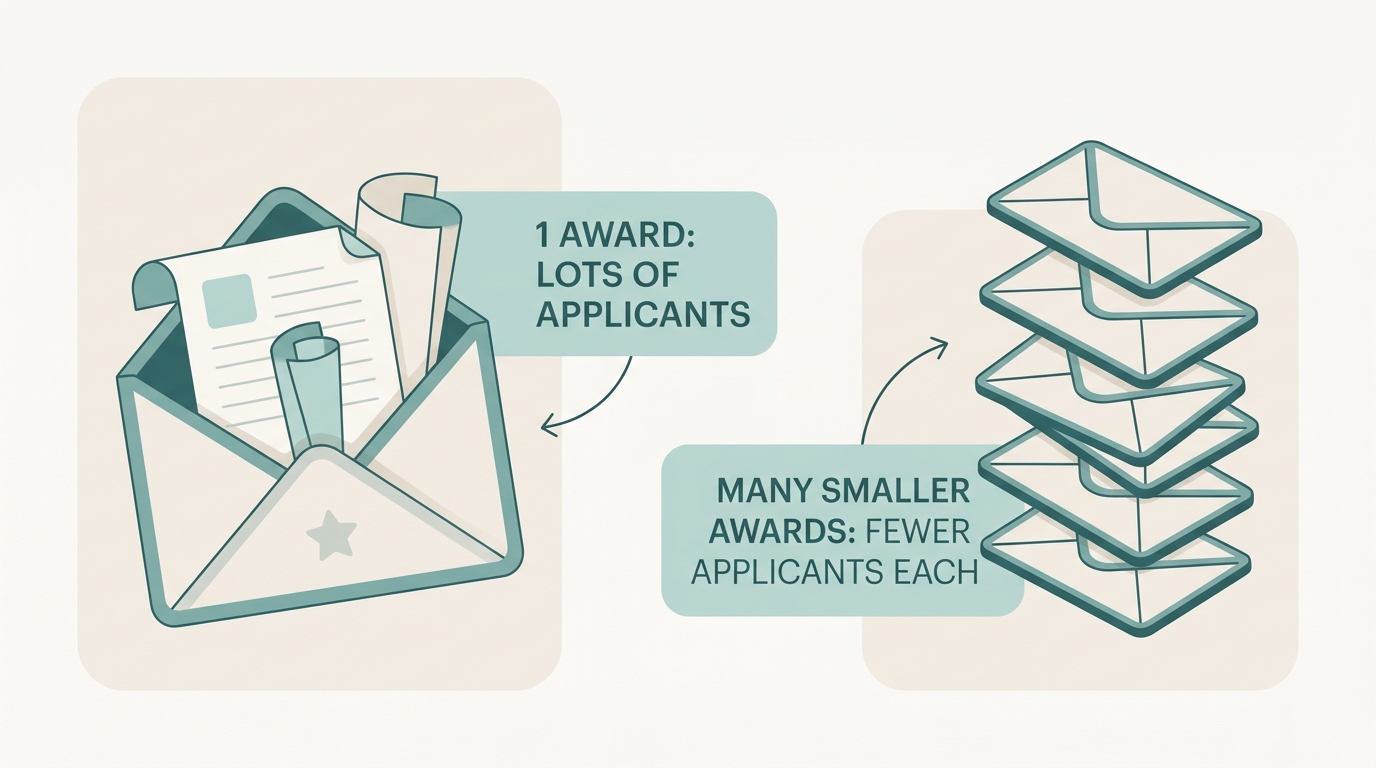
When the workflow is right, applying to twenty small awards takes about the same time as applying to two big ones, and the expected return is higher.
Where do small scholarships leave you?
In a good place, usually. Most students who put in a serious application cycle find that the money comes from a stack of small and medium awards, not a single big one. A few hundred dollars here, a thousand there, an unexpected state association award in April — the total adds up faster than a single marquee scholarship would.
The honest version: no one can promise you'll win anything. Each award is decided by its own provider. What you can do is put yourself in front of more well-fit opportunities with less per-application friction — and that math is genuinely on your side. Start searching for the small awards that fit you — free to start, no card required.
Quick answers
Is it worth applying for $100 or $250 scholarships?
Yes. The dollar amount is small, but the applicant pool is usually small too — your odds of winning are often better than for a $10,000 national award. Five $250 wins cover a textbook semester.
Do small scholarships have a lower chance of winning?
No, the opposite. The defining feature of a small scholarship is usually a smaller applicant pool, not a lower-quality applicant. Your personal hit rate is typically much higher.
How do I find legitimate small scholarships?
The tells of a legitimate small scholarship are the same as for any legitimate scholarship: no application fee, a clear sponsor (a club, foundation, hospital, or company), a public contact, a posted deadline, and eligibility rules that are checkable. If any of those are missing, see our scholarship scam red flags guide.
How many small scholarships should I apply to in a year?
There is no single number, but thirty to fifty small and medium awards is a realistic annual target for a high-school senior or undergrad with a steady weekly rhythm. Quality of fit matters more than raw count.
Are small scholarships less competitive than national ones?
Usually yes — that's the central practical reason they exist. Local and niche awards can't attract the same national Google traffic the marquee awards do, so the applicant pool is naturally smaller. Submitting good applications to well-fit smaller awards is one of the highest-return things a student can do.
Do small scholarships pay less in total than big ones?
Often they pay more in total. Most successful applicants describe stacking ten or more smaller awards to cover a meaningful share of costs. A single $10,000 win is great when it happens, but most students who close a real funding gap do it across many smaller awards.
Still searching for scholarships manually?
Find scholarships you actually qualify for — AI matches you in minutes. Free to start.
Find My Scholarships →