
July 13, 2026
Scholarships for High School Seniors: A Month-by-Month Plan
Start the summer before senior year, not in spring. High-school-senior scholarship deadlines cluster from October through March, but real awards close in every month of the year. The winning move isn't cramming: it's applying steadily, a few each month, filing your FAFSA in the fall, and keeping every deadline in one place.
Senior year fills up fast — college apps, tests, actual classes — and scholarships are the thing most students push to “later,” then panic about in April. It doesn't have to go that way. Scholarship money is spread across the whole calendar, and the students who apply to the most are usually the ones who started early and did a little at a time. Here's a month-by-month plan for when to look, when the big deadlines hit, and how to keep it from swallowing your whole spring.
When should high school seniors start applying for scholarships?
As early as the summer before senior year — and if you're already past that, today. Scholarships aren't tied to the college-application calendar. Some close months before your first application is even due, and a few of the biggest national awards have deadlines in the fall. Starting early does two things: it eases you into an “apply to a few each month” rhythm, and it means you don't quietly lose the fall and winter awards that most students never see because they wait until spring.
You don't need a final college list to start. A general essay, a résumé or activities list, and one or two recommendation letters are enough to apply to most awards — and you can reuse all of them again and again.
The month-by-month scholarship timeline for senior year
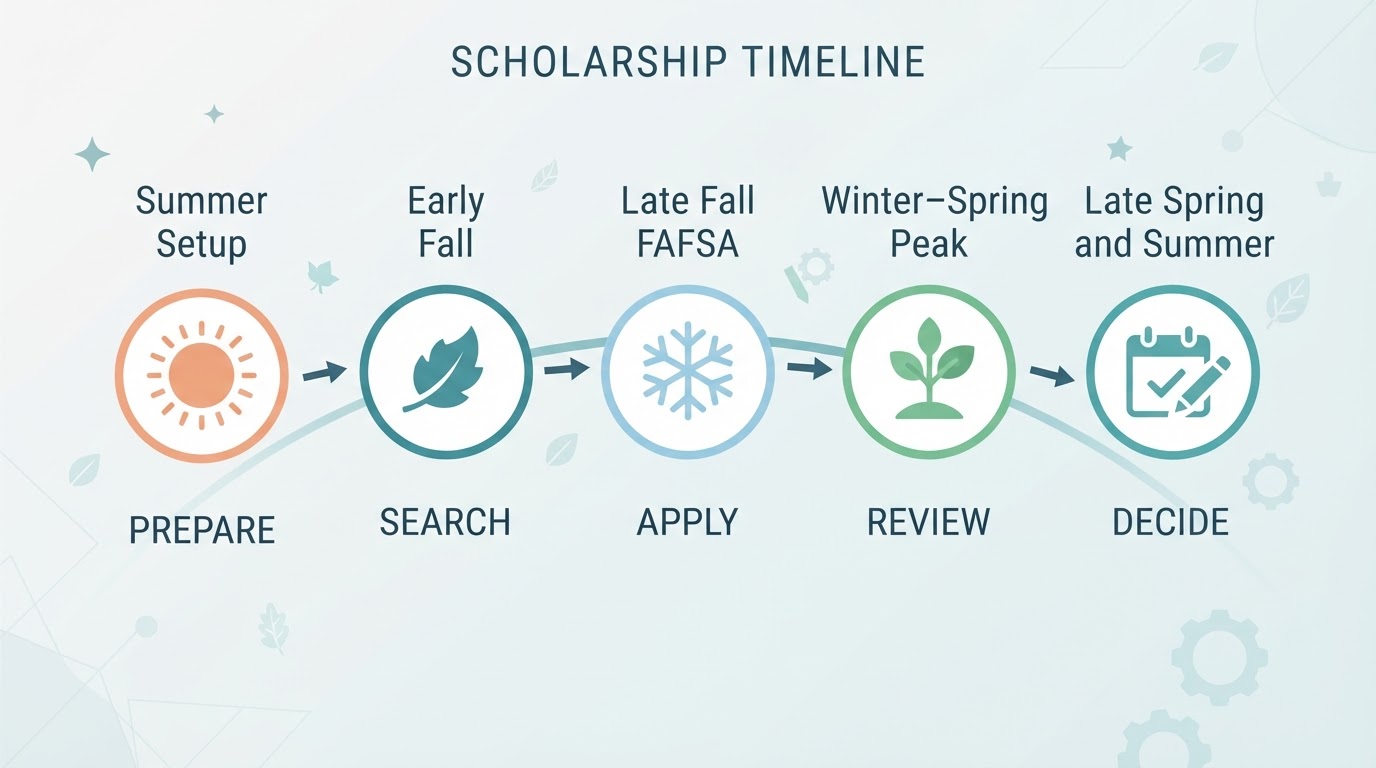
Here's the whole year, season by season, with the kinds of deadlines that actually fall in each window. A few real awards are noted as examples — the same dates repeat every year, so use them to picture the rhythm, not as a to-do list.
Summer before senior year (June–August)
This is your setup season, and it's the one almost everyone skips. Use it to build a simple system before things get busy:
A running list of awards with their deadlines and requirements.
One strong general essay you can adapt for most applications.
A résumé or activities list you can attach again and again.
Summer deadlines are real, too — the Courage to Grow Scholarship is a $1,000 award that closes June 30, and summer awards tend to draw fewer applicants because most students have checked out. An hour a week now saves you a frantic April later.
Early fall (September–October)
This is prime scholarship season, and where the early habit pays off. Many awards open in early fall, and some of the largest national scholarships close before winter break — so don't save the big ones for spring. Start with a few low-effort no-essay scholarships to build momentum, then work up to the ones that need an essay. Filter to your grade so you're only looking at scholarships for high school seniors you can actually apply to right now. One caution as you go: legitimate scholarships never charge a fee to apply, so if one wants money to “process” your application, skip it — the FTC's guidance on scholarship scams is a two-minute read worth doing before you hand over any personal information.
Late fall (November–December): file the FAFSA
Two things happen here. First, more merit deadlines land — the TMEA scholarship for high school seniors, for example, closes November 1. Second, and more important: file your FAFSA. Even if you're chasing merit awards, the FAFSA is required for federal and state need-based aid, and some private scholarships ask for it too. It opens in the fall — file as soon as it's available at fafsa.gov and well before any state deadline, since some aid is first-come, first-served. If the whole aid picture feels murky, the CFPB's Paying for College explains grants, loans, and scholarships in plain language.
Winter to spring (January–April): peak deadlines
This is the busiest stretch — most senior-year deadlines cluster from October through March, and late winter into early spring is the peak of it. The trap is letting them all pile onto one weekend. Pace it: submit a few applications every month instead of thirty in April. Plenty of general awards close here, like a four-year merit scholarship for high school seniors due March 15. Awards tied to your own story count too — the Life Lessons Scholarship, for students who've lost a parent, closes in early March. Your circumstances and background are eligibility, not a disadvantage.
Late spring and summer (May–August): don't stop
May 1 is the big one — the standard date colleges use for enrollment decisions and many aid packages — so have your commitment and paperwork sorted by then. But scholarships don't end in May. The Long Island Music Hall of Fame scholarships close May 15, and a fresh batch of summer awards opens for the next cycle. Late-spring and summer awards are often the least competitive of the year, precisely because everyone assumes the season is over. If you're starting late, that's your proof it isn't too late.
Why applying steadily beats cramming
Because steady wins on both math and quality. Submit one application a month for a year and that's twelve shots instead of the three or four you'd manage in a spring scramble — and even a modest hit rate on twelve beats one great essay you were too rushed to finish. No one can promise you'll win any particular award; each is decided by its own committee. But more thoughtful applications, spread out, is the part you actually control.
Spacing them out also makes each one better. When you're not writing five essays the night before, you write stronger ones, ask for recommendation letters with enough notice, and actually proofread. Rushed applications look rushed.
How do I keep track of every scholarship deadline?
Keep one list, sorted by deadline, and set a reminder a few days before each one. Awards rarely slip away because they were hard to win — they slip because their deadlines are scattered across the year and easy to forget. For every award, note the name, what it requires, and when it's due, then work backwards: if you need three recommendation letters, start asking a month out.
Browsing awards by when they close helps you plan the next few weeks — scholarships closing soon is a quick way to see what's urgent without digging through a dozen sites.

A calmer way to stay on top of senior-year scholarships
Doing all of this by hand means a spreadsheet, a wall of browser tabs, and deadlines you're just hoping you didn't miss. That's the part ScholiBuddy takes off your plate. You can filter a database of 50,000+ scholarships down to the ones that fit your grade, state, and background, so the awards worth your time rise to the top — and you can keep every deadline in one place instead of ten. We can't tell you which ones you'll win, because that's up to each provider, but we can make sure the right ones are in front of you at the right time. It pairs well with a plan for finding local scholarships and awards for your major, where your odds are often best.
Start searching free — no credit card required.
Quick answers
When should I start applying for scholarships in high school?
Ideally the summer before senior year, but earlier is fine and later still works. Underclassmen can win awards too, and even a late start senior year is worth it — the key is to treat it as an ongoing habit, not a one-time spring sprint.
What month has the most scholarship deadlines?
Most high-school-senior deadlines fall between October and March, and late winter into early spring is the busiest stretch. Fall carries a wave of big national awards — which is exactly why spreading applications across the year keeps you sane.
Do I need to file the FAFSA to get scholarships?
Not for every private scholarship, but yes for federal and state need-based aid, and some private awards ask for it. File the FAFSA in the fall as soon as it opens; it's free at fafsa.gov, and filing early can mean more aid because some funds run out.
Is it too late to apply for scholarships as a second-semester senior?
No. Late-spring and summer awards are often the least competitive of the year because most students stop looking. Keep applying through May, June, and beyond — the next cycle's awards start opening while everyone else assumes the season is over.
How many scholarships should a high school senior apply to?
There's no magic number, but a steady pace — a few a month across the year — beats a single spring binge. More applications means more chances, and spacing them out keeps the quality high. Start with awards you clearly qualify for, including smaller local and niche ones where fewer people apply.
Still searching for scholarships manually?
Find scholarships you actually qualify for — AI matches you in minutes. Free to start.
Find My Scholarships →